If you have spent any time reading about healthy homes, you will have met a puzzle. All the advice points towards airtightness: seal the gaps, stop the draughts, stop paying to heat air that leaks straight back out. And the natural response is to ask the obvious question. If the house is sealed, where does the fresh air come from?
It is a fair question, and it deserves a proper answer rather than a hand-wave. In most Passivhaus homes, the answer is a quiet piece of equipment called a heat recovery ventilator, or HRV. It is one of the least visible things in a high-performance home, and one of the hardest working.
This article walks through what an HRV actually does, how the heat recovery part works, and what it means for the way your home feels day to day.
Every home has two jobs to do at once
A home has to hold its temperature, and it has to refresh its air. Most Australian homes do the second job by accident: air leaks in through gaps around windows, downlights and skirting boards, and leaks out again somewhere else. That accidental ventilation is unreliable. It over-delivers on a windy winter night, exactly when you are paying to stay warm, and under-delivers on a still, humid day, exactly when you want the moisture gone.
As a home gets more airtight, the accidental ventilation disappears, so the fresh air has to be provided on purpose. The Australian Government's YourHome guide to ventilation and airtightness makes the point directly: as airtightness improves, reliable ventilation becomes more important, and opening windows does not count as reliable, because it depends on someone remembering to do it, at the right times, all year round.
That is the job the HRV takes on. It ventilates the home deliberately, continuously and quietly, whether anyone is thinking about it or not.
What an HRV actually does
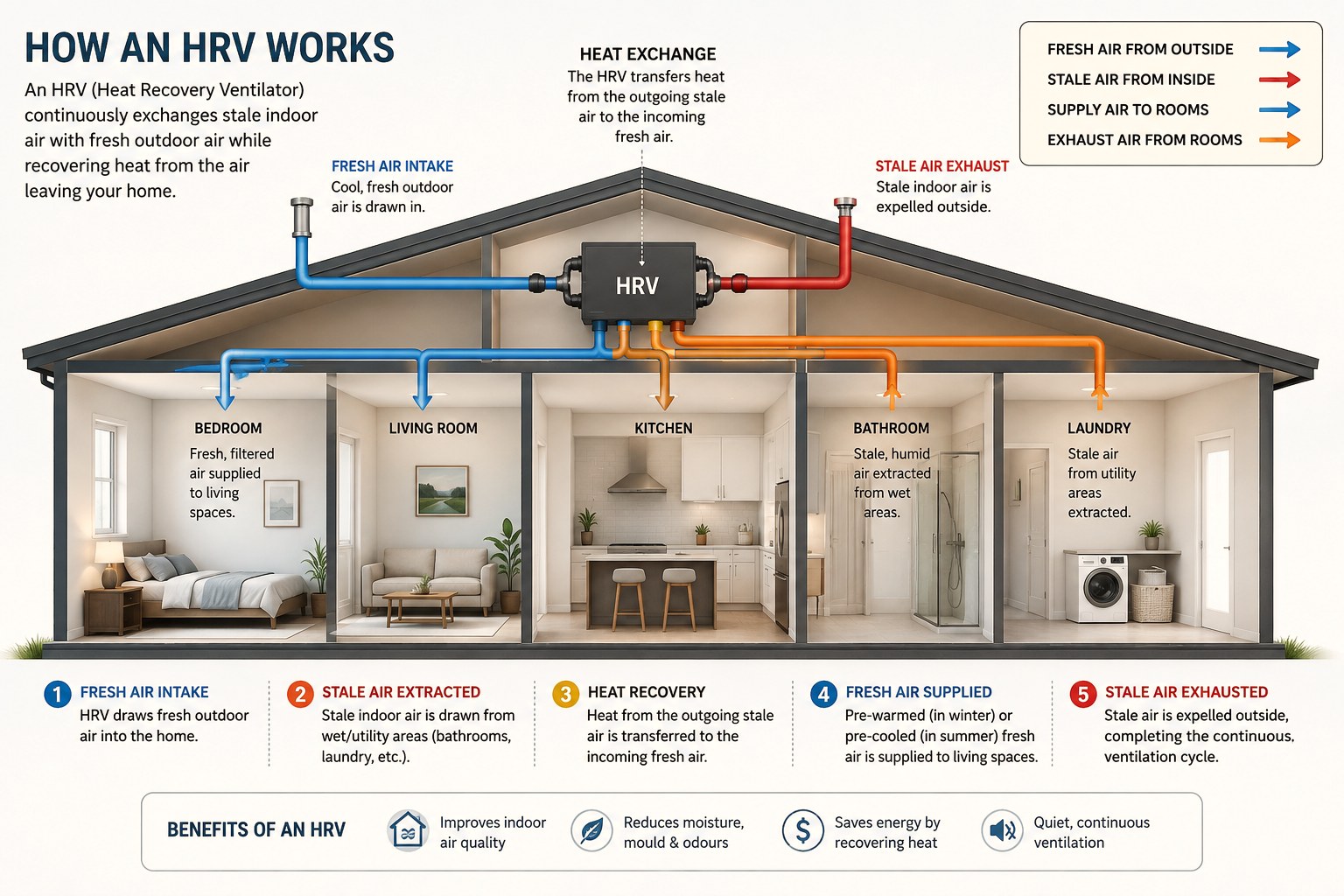
An HRV runs two gentle air streams at the same time, all day and all night.
One stream draws stale, moist air out of the rooms that produce it: the bathrooms, the laundry, the kitchen. Steam from the shower, moisture from cooking and drying clothes, and the general staleness that builds up in occupied rooms all leave the house at the source, before they can drift into the rest of the home.
The other stream supplies fresh, filtered outdoor air to the rooms where you spend your time: the bedrooms and living spaces. The filter matters more than people expect. Pollen, dust and smoke are removed on the way in, which is a genuine relief if you live near a busy road or anywhere bushfire smoke reaches.
The Australian Passivhaus Association describes heat recovery ventilation as the lungs of a Passivhaus, and it is an accurate picture: a steady breathing cycle for the whole house, running in the background.
On its own, though, that swap would carry a cost. Every litre of air pushed outside in July is air you have already paid to warm. This is where the heat recovery part earns its name.
The clever part: the heat exchange core
Inside the unit, the two air streams pass through a heat exchange core without ever mixing. In many units this core is ceramic, a material that soaks up and releases heat readily.
Through winter, it works like this. The warm air leaving the house brings the core up to the indoor temperature as it passes through on its way out. The cold outdoor air then comes in through that warmed core and collects the warmth on its way through, arriving inside already close to room temperature.
In other words, the energy you spent heating the house is captured at the exit and handed to the incoming air. An HRV typically recovers around 80 per cent of that energy. You get completely fresh air, at nearly the temperature of the air it replaced, for the cost of running two quiet fans.
The two streams stay fully separated the whole way through. The outgoing air never mingles with the incoming air; only the heat crosses over. What arrives in your bedroom is genuinely outdoor air, filtered, at close to indoor temperature.
It works in summer too
The same principle runs in reverse. When it is hot outside and you have used energy to cool the house, the outgoing cool air brings the core down to the indoor temperature, and the incoming hot air sheds its heat to the core on the way in. The fresh air arrives pre-cooled, and the cooling you have already paid for stays largely inside.
That symmetry matters on this coast, where the real comfort problem is not one long freezing winter but both ends of the year: cold snaps in July and long humid stretches in February. The HRV is doing useful work in both.
What this means day to day
The mechanics are interesting, but the lived experience is the point.
- Bedrooms feel fresh in the morning. Sleeping people fill a closed room with carbon dioxide overnight. With continuous supply air, you wake in a room that feels aired out, without having slept next to an open window in winter.
- Moisture leaves before mould can use it. Bathrooms and laundries are ventilated constantly, not just while someone remembers to run a fan. Less lingering moisture means less condensation on cold surfaces and less pressure towards mould.
- The air is filtered. Pollen, dust and smoke are caught on the way in. For hay fever sufferers, and on poor air quality days, the difference is noticeable.
- It is quiet, and there are no draughts. A well-designed system is close to silent, and the air movement is gentle enough that you will not feel it. You notice the absence of stuffiness, not the presence of a system.
- The windows still open. An HRV does not lock you in. On a beautiful afternoon, open everything up. The system simply means the house is properly ventilated during all the hours the windows are shut.
The real trade-offs
An HRV is not a gadget you clip onto any house. It needs to be designed alongside the home: duct runs planned early, the unit sized to the floor area, and the system commissioned properly so the air volumes are balanced. The fans use a small amount of electricity, far less than the value of the heat they recover, and the filters need changing on a simple schedule, much like a car service.
It also earns its keep in proportion to the airtightness of the building around it. In a leaky house, air keeps taking the accidental route around the system, so the envelope and the ventilation need to be resolved together. That is why we treat ventilation as a design decision made early, not equipment chosen at the end.
Designed in, not bolted on
The homes that feel effortlessly fresh are the ones where the building envelope and the ventilation were resolved together, on paper, before anyone was on site. If you are planning a new home or a major renovation and want to understand what that looks like for your project, we are happy to talk it through.
AGATHĒ builds architectural and Passivhaus homes across Sydney's North Shore, the Northern Beaches, the Hills district, the Central Coast and Newcastle, and their surrounds. Our founder Mitch Chan is a Certified Passivhaus Tradesperson, and we are members of the Australian Passivhaus Association. If you are weighing up what healthy, deliberate ventilation would look like in your renovation or new build, we are always happy to talk it through.
Start a ConversationNot at the conversation stage yet? That is completely fine. If this topic has you curious, the Healthy Homes newsletter is the easy way to keep learning, with no obligation attached.